Water intrusion does not announce itself. It starts quietly — a weakened mortar joint here, a failed sealant line there, a section of facade that has been exposed to one too many Michigan winters. By the time visible symptoms appear, moisture has often already been working through the wall assembly for months or years.
Understanding how water actually moves through a commercial masonry building — and what it damages along the way — is what separates a property team that catches problems early from one that is always reacting to them.
Why Masonry Buildings Are Vulnerable to Water Intrusion
There is a common misconception that masonry is inherently waterproof. It is not. Brick, block, stone, mortar, and concrete are all porous to varying degrees. They absorb moisture, slow it down, or transmit it — depending on material density, condition, and exposure.
In a freeze-thaw climate like Michigan’s, that porosity creates a specific and predictable problem. Moisture enters the wall. Temperatures drop. Water freezes inside the masonry and expands — putting stress on the surrounding material from within. Temperatures rise. The ice thaws, the material contracts, and the cycle repeats. Every freeze-thaw cycle widens existing cracks, weakens mortar bonds, and opens new pathways for the next round of moisture.
That is why water intrusion in commercial masonry does not tend to stay static. It moves in one direction: deeper, wider, and more expensive.
The Primary Entry Points for Water in Commercial Masonry
Water does not need a large opening to cause serious damage. The most significant moisture pathways on commercial buildings are often the ones that get overlooked because they look minor.
Mortar Joints
Open, eroded, or cracked mortar joints are the most common entry point for water on commercial masonry buildings. Mortar is softer and more porous than the masonry units it holds together — which means it weathers faster. As joints erode, they create wider channels for water to enter the wall and travel laterally through the assembly. In Michigan, tuckpointing is not a cosmetic service — it is a core component of keeping moisture out of the building envelope.
Failed Sealant Lines and Perimeter Transitions
Control joints, perimeter joints around windows and doors, and transitions between dissimilar materials all rely on sealants to stay watertight. Sealants have a service life. When they crack, shrink, split, or pull away from the substrate, those transitions become unprotected moisture entry points. Because sealant failure is not always visible from the ground, it is frequently missed until interior leaks or facade damage start appearing.
Cracked Masonry Surfaces
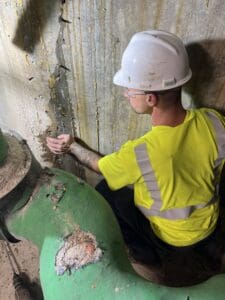
Cracks in brick, block, stone, or concrete are not just cosmetic. They are direct moisture pathways into the wall assembly. Fine cracks may only allow capillary moisture movement — but in freeze-thaw conditions, capillary moisture is enough to begin enlarging the crack from within. Wider cracks allow bulk water entry during rain events. Either way, untreated cracks in a masonry facade are an active moisture risk.
Parapets, Copings, and Top-of-Wall Transitions
Water intrusion frequently originates at the top of the building — not the bottom. Parapets take direct weather exposure from above, below, and the sides. When coping joints open, coping stones crack, or top-of-wall flashing deteriorates, water enters the wall assembly at its highest point and migrates downward through the facade. By the time staining appears at eye level, the moisture pathway may have been active for a long time.
Below-Grade and Lower-Wall Transitions
At grade and below, commercial masonry buildings are vulnerable to hydrostatic pressure, poor drainage conditions, and deteriorated waterproofing. Lower-wall masonry often shows the effects of ground moisture, snowmelt contact, and failed waterproofing transitions before other parts of the building. These conditions are frequently underestimated because the damage can look like normal weathering until it becomes a more significant problem.
What Water Intrusion Does to Masonry — Layer by Layer
Moisture damage in commercial masonry buildings tends to follow a predictable sequence. It rarely starts as a large-scale failure. It builds.
Stage 1: Mortar Weakening and Joint Erosion
Mortar is typically the first material to show water-related deterioration. Repeated moisture exposure softens the joint, dissolves binding agents, and reduces the mortar’s ability to resist further weathering. As joints erode, they allow more water in — which accelerates the deterioration of both the mortar and the adjacent masonry units.
Stage 2: Efflorescence and Staining
As water moves through masonry, it carries soluble salts with it. When that moisture reaches the surface and evaporates, it leaves white mineral deposits — efflorescence — on the face of the wall. Dark staining typically follows repeated moisture exposure in the same area. Both are symptoms of an active moisture pathway, not isolated cosmetic issues. Cleaning the surface removes the deposit. It does not address the source.
Stage 3: Brick Spalling and Surface Material Failure
When moisture saturates masonry and then freezes, the expansion exerts outward pressure on the face of the brick. Over repeated cycles, this pressure causes the face of the brick to delaminate, flake, or break away — what is commonly called spalling. Spalled brick not only looks deteriorated; it exposes the interior of the masonry unit to direct moisture contact, accelerating further breakdown. On commercial buildings with significant spalling, restoration scope can grow quickly.
Stage 4: Steel Corrosion and Structural Implications
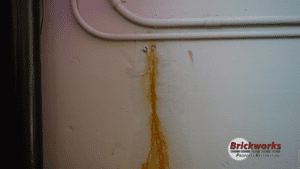
This is the stage that changes the conversation most significantly. Commercial masonry buildings rely on embedded or adjacent steel components — lintels spanning window and door openings, shelf angles supporting brick veneer, relief angles at floor lines, and in some cases steel frames or anchors within the wall assembly. When water reaches these components, oxidation begins. As steel corrodes, it expands — sometimes to many times its original volume. That expansion puts direct pressure on surrounding masonry, causing cracking, displacement, and spalling in patterns that often look like they originate from within the wall. Rust staining on a masonry facade is not a warning that something might happen. It is confirmation that it already is.
Stage 5: Facade Movement and Assembly Compromise
Once moisture has weakened mortar, degraded masonry units, and corroded supporting steel, the wall assembly as a whole becomes less stable. Sections may begin to bulge or bow as internal pressure builds. Joints between the veneer and the structure may open. Materials that were once held in place by sound mortar and intact anchors are now relying on less. At this stage, the repair conversation has shifted from restoration to structural stabilization — a significantly different scope and cost.
The Interior Symptoms of Exterior Masonry Moisture Problems
One of the most consistent mistakes property teams make is treating facade moisture as an outside problem. By the time water intrusion is affecting the building envelope in the ways described above, interior symptoms are almost always present too.
- Recurring leaks near windows, corners, and exterior walls that return even after roof repairs
- Damp or stained drywall along perimeter walls, particularly at floor and ceiling transitions
- Persistent musty odors or elevated humidity in spaces adjacent to exterior walls
- Staining on interior finishes that cannot be explained by plumbing or HVAC issues
- Maintenance requests that recur in the same location without a clear or permanent fix
When these interior symptoms align with exterior masonry deterioration, the two should be evaluated together — as a building envelope system — not in isolation.
Why Delay Makes Commercial Masonry Water Damage More Expensive
The economics of commercial masonry repair are straightforward. The earlier the moisture pathway is identified and addressed, the more contained the repair scope.
A failed mortar joint addressed early is a tuckpointing project. Left alone, it becomes a spalling and joint replacement project. Left longer, it becomes a steel corrosion and masonry restoration project. Each stage of delay adds material cost, labor cost, and often scheduling disruption for tenants and operations.
There is also a less obvious cost: uncertainty. When moisture has been moving through a commercial masonry wall for years, the full extent of damage behind the surface is unknown until the wall is opened. That uncertainty makes accurate scoping difficult and project budgeting harder. Early evaluation — before conditions reach that stage — gives property teams far more control.
FAQ
How does water intrusion damage commercial masonry buildings?
Water moves through joints, cracks, porous materials, and failed transitions. Over time, that moisture causes spalling brick, eroded mortar joints, staining, steel corrosion, facade distress, and interior leaks. In freeze-thaw climates like Michigan, each winter cycle accelerates the damage.
What are the first signs of water damage in masonry walls?
Common early signs include efflorescence, dark staining, open or eroded mortar joints, cracked masonry, recurring leaks near exterior walls, and surface flaking or spalling. These typically appear before structural or steel-related damage becomes visible.
Can water intrusion cause structural damage in a commercial building?
Yes. When moisture reaches embedded steel components — lintels, shelf angles, anchors — corrosion begins. Corroding steel expands, placing pressure on surrounding masonry and causing cracking, displacement, and potential facade instability. This is one of the more serious consequences of long-term unaddressed water intrusion.
Why is freeze-thaw weather so damaging to masonry buildings?
When water enters masonry and freezes, it expands inside the material. That repeated expansion and contraction puts stress on brick, mortar, joints, and facade components — widening cracks, weakening bonds, and accelerating deterioration over each winter season.
What is the difference between efflorescence and more serious water damage?
Efflorescence is a surface deposit of salts left behind as moisture evaporates through masonry. It is a symptom of moisture movement, not the damage itself. The damage — eroded mortar, spalling masonry, corroding steel — happens within the wall assembly. Efflorescence is an indicator that the wall should be evaluated; it is not something that resolves on its own.
When should a property manager schedule a site visit for masonry water damage?
When moisture-related symptoms are recurring, spreading, or tied to visible masonry deterioration, facade distress, or interior leaks. The earlier an evaluation happens, the more options the property team has on scope, timing, and cost.
Know What Is Actually Happening Inside Your Walls.
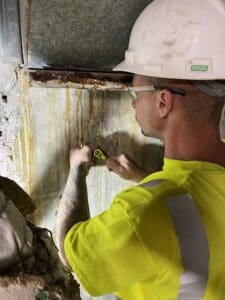
Surface symptoms — staining, spalling, cracked joints — are visible indicators of a moisture problem. What is happening inside the wall assembly may be further along than what you can see from the ground.
Brickworks Property Restoration works with commercial property owners, facility teams, and project managers across Metro Detroit and Southeast Michigan to identify where water is getting in, how far the damage has progressed, and what repair scope makes sense. Whether the issue involves masonry restoration, waterproofing, facade repair, or steel-related damage, early evaluation gives you clarity before the problem forces your hand.
Submit a service request to schedule your commercial masonry and waterproofing assessment.