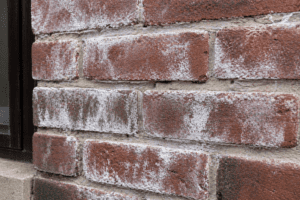
Sub-efflorescence is common in older masonry buildings where water infiltration has been ongoing for extended periods, and it is irreversible in the affected units. Brick that has spalled cannot be patched back to structural integrity — the units must be replaced. This is a significant distinction for property owners and managers evaluating older building stock, and it underscores why addressing moisture infiltration early, before chronic saturation sets in, is a fundamentally different cost proposition than addressing it after spalling has begun.
Interior Dampness: Reading the Location
Interior dampness in commercial buildings follows predictable patterns based on where moisture is entering the assembly. Reading those patterns correctly is what separates targeted remediation from repeated failed repairs.
Dampness at the ceiling line or top of interior walls typically traces to conditions at the roof-wall interface — failed flashing at the parapet, open coping joints, or deteriorated cap conditions that are allowing water to enter above the roofline and migrate down through the wall assembly or along the roof deck.
Dampness at window and door frames points to failed perimeter sealant, inadequate or missing window head flashing, or sill conditions that are directing water into the rough opening rather than away from it. In brick veneer construction, this can also indicate failed ties or cavity conditions that are allowing water to bypass the designed drainage path.
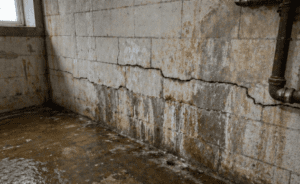
Dampness in lower floors or below-grade spaces that correlates with rainfall events suggests active infiltration — either through foundation walls under hydrostatic pressure, through floor slab cracks, or through the wall-floor interface. Dampness in these spaces that is present continuously regardless of weather may indicate rising damp or condensation driven by temperature differentials.
Tide marks on interior walls — horizontal staining lines that appear consistently at the same elevation — indicate cyclical moisture saturation. The stain line represents the high-water mark of moisture migration through the assembly over repeated wetting and drying cycles. In below-grade spaces, this pattern often maps directly to subsurface drainage conditions or to the height at which hydrostatic pressure is acting against the wall.
Masonry Staining Beyond Efflorescence
Not all masonry staining traces to salt deposits. Several other staining types appear on commercial facades, each pointing to different conditions.
Dark streaking and biological staining — algae, lichen, and mold growth on masonry surfaces — indicates chronic moisture retention. Masonry that is staying wet for extended periods, whether from poor drainage, north-facing exposure with limited drying, or surface conditions that trap moisture, provides an environment for biological growth. Beyond aesthetics, biological growth on masonry accelerates surface deterioration by introducing organic acids that attack mortar and some masonry units over time.
Rust staining appearing as orange or brown streaks on brick or stone facades typically indicates corroding embedded metal — shelf angles, lintels, brick ties, or reinforcing steel. When embedded steel corrodes, it expands. That expansion generates significant internal pressure, cracking the masonry above and around the corroding element. Rust staining is not a facade maintenance issue — it is a structural indicator that warrants investigation. The visible stain is evidence of a subsurface corrosion process that may have been progressing for years.
Formwork and construction staining is common on older concrete and masonry buildings and is generally aesthetic in nature, though it can obscure other conditions during visual inspection.
Calcium and lime staining that runs from mortar joints or concrete elements is related to the same leaching process that produces efflorescence, and carries the same implication: water is moving through the assembly and carrying dissolved material to the surface.
Why These Symptoms Matter to Property Managers, Engineers, and Owners
The practical significance of these visible conditions depends on context — the building’s age, construction type, use, exposure history, and the duration and severity of the symptoms. But in every case, visible moisture-related conditions on a commercial facade warrant assessment rather than cosmetic treatment.
For property managers, unexplained staining and interior dampness are often early warnings of conditions that will escalate in cost if left unaddressed. For engineers evaluating existing buildings, the distribution and character of these symptoms is diagnostic information — rust staining, spalling patterns, and crack locations together tell a story about the structural and envelope performance of the building that goes well beyond surface appearance.
Cleaning a facade, applying a sealer, or running a dehumidifier in a damp space treats the evidence. Addressing the moisture pathways that produced it — through systematic envelope assessment, identification of the source, and properly sequenced repair work — is what changes the building’s long-term performance.
Water leaves marks. The marks are worth reading.