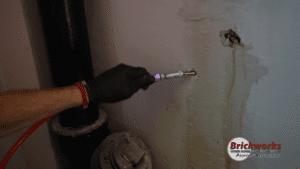
Water doesn’t announce itself. By the time a property manager notices a stain on a ceiling tile or a facility team spots efflorescence creeping across a brick facade, the moisture has usually been moving through the building envelope for months, sometimes longer.That’s the nature of commercial building leaks. The visible damage and the actual source are rarely in the same place.Understanding where leaks originate, and why they escalate quickly, is the difference between a targeted repair and an expensive remediation project that could have been avoided.The Building Envelope Is Only as Strong as Its Weakest Transition
Commercial buildings don’t fail in the middle of a wall. They fail at the edges, wherever two materials meet, wherever movement occurs, wherever a penetration breaks the continuity of the assembly.The most common leak origin points on commercial masonry and mixed-construction buildings include:
- Failed sealant joints. Expansion joints, control joints, and perimeter sealant at window and door frames are designed to flex with building movement. When sealant ages, loses adhesion, or was improperly installed to begin with, those joints become direct water entry points. In Michigan, where buildings cycle through freeze-thaw dozens of times per season, sealant that isn’t spec’d correctly or maintained regularly degrades faster than in more temperate climates.
- Coping and parapet conditions. The top of a masonry wall is one of the most vulnerable areas on any commercial building. Coping stones that have shifted, open head joints, missing or deteriorated cap flashing, and improperly sloped or back-pitched coping all allow water to enter directly into the wall assembly from above. Once water infiltrates a parapet, gravity and capillary action take it wherever the path of least resistance leads — which is rarely where you’d expect it to surface.
- Flashing transitions and terminations. Flashing is what keeps water from migrating at the intersection of the roof and wall, around window openings, at shelf angles, and at other horizontal interruptions in the facade. When flashing is missing, poorly lapped, not embedded correctly, or has been disturbed by prior repair work, it creates a concealed leak pathway that can funnel water deep into the assembly before any indication appears inside.
- Wall penetrations. Conduit, pipes, HVAC equipment, and signage that penetrate the facade all require proper sealing and, in many cases, through-wall flashing. These are frequently the last thing anyone looks at during routine maintenance, and they’re among the most reliable sources of long-term slow leaks.
- Mortar joint deterioration. In older masonry buildings — particularly the brick construction common across Michigan’s industrial and institutional building stock — mortar joints erode over decades. What looks like surface weathering often represents significant voids that are channeling water directly into the wall. This is especially pronounced in buildings where prior repointing work used a mortar mix that was too hard for the original masonry, causing accelerated joint failure and, in some cases, spalling brick.
Why Michigan Makes This Worse
Every building envelope faces moisture risk. In Michigan, that risk is compounded by a climate that is genuinely hostile to building assemblies.The freeze-thaw cycle is the primary accelerant. Water that enters a wall cavity, a joint, or a crack during a rain event doesn’t stay in liquid form. When temperatures drop, and in Southeast Michigan, they drop hard and repeatedly from November through March, that water expands as it freezes. It widens cracks, breaks mortar bonds, pushes against masonry units, and compromises sealant adhesion. When it thaws, it withdraws, leaving slightly larger openings for the next infiltration event.Over a single season, a minor sealant gap or a hairline crack in mortar can become a significant water pathway. Over five seasons without intervention, the structural implications can extend well beyond the facade itself.Clay-heavy soils common throughout Macomb and Wayne counties add hydrostatic pressure to the equation for below-grade walls and foundation-adjacent masonry. As clay absorbs moisture and expands, it exerts lateral pressure against walls that were never designed to manage that load indefinitely, accelerating crack development and forcing moisture against the building envelope from the outside in.Why Leaks Spread Faster Than Most Teams Expect
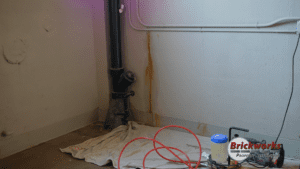
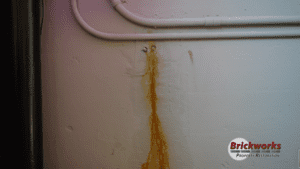
The reason commercial building leaks tend to become expensive problems isn’t that buildings fail suddenly. It’s that water is patient, and most maintenance schedules aren’t built to catch early-stage infiltration.Water entering a facade at the parapet level doesn’t necessarily surface at the parapet. It follows the path of least resistance, through mortar joints, along shelf angles, through insulation, down interior wall assemblies, and it surfaces somewhere else entirely. A stain on a third-floor interior wall might be tracing back to a flashing failure at the roof edge two stories up. Interior dampness in a ground-floor suite might originate at a failed window sill ten feet above it.This disconnect between source and symptom is what causes property teams to repair the wrong thing repeatedly, without ever solving the actual problem. It’s also why leak investigation on commercial buildings requires systematic envelope assessment — not just surface-level patching wherever water appears.The secondary damage compounds quickly once water is moving through an assembly. Steel shelf angles begin to corrode, expanding as rust forms and cracking the masonry above. Wood blocking and nailers absorb moisture and deteriorate. Insulation loses thermal performance. In buildings with older construction, the consequences can move from aesthetic to structural in a shorter timeframe than most owners anticipate.What a Competent Assessment Actually Looks Like
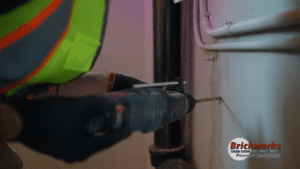
Addressing a commercial building leak correctly starts with finding the real source, not the most obvious symptom.A thorough envelope assessment involves tracing visible water intrusion back through the assembly, examining coping conditions, sealant joints, flashing terminations, penetrations, and mortar integrity as a system rather than in isolation. In many cases, conditions that aren’t yet leaking are already compromised and will fail within one or two seasons. Identifying those points during a primary investigation changes the repair scope from reactive to proactive.From assessment to repair, the goal is the same: restore the continuity of the building envelope so water has no path in. That means the right materials for the specific assembly, proper detailing at every transition, and work that holds up to the conditions Michigan actually delivers, not just the conditions the spec assumed.Buildings don’t forgive deferred maintenance on envelope conditions. The freeze-thaw cycle runs on its own schedule, and it doesn’t wait for budget season.The property managers, engineers, and facility teams who stay ahead of water intrusion share one thing in common: they know what to look for before the ceiling tile tells them.Protect Your Building Before Small Leaks Become Major Repairs
Water intrusion rarely stays small—and by the time it’s visible, the damage is already underway. At Brickworks Property Restoration, we help property managers, engineers, and facility teams get ahead of the problem with comprehensive building envelope assessments and targeted repairs built for Michigan’s climate.
Don’t wait for visible damage to dictate your next move.
Our team identifies the true source of leaks—whether it’s failing sealant, compromised flashing, deteriorating mortar, or parapet issues—and addresses them with long-term solutions, not temporary patches.
- Full building envelope inspections
- Leak source identification (not just symptom repair)
- Masonry restoration, tuckpointing & waterproofing
- Parapet, coping & flashing repair
- Preventive maintenance strategies
Stay ahead of freeze-thaw damage and costly remediation.
Schedule a professional assessment today and keep your building protected year-round.Request your consultation with Brickworks Property Restoration